AI-first intake for insurance agencies
Straight into your AMS. The AI builds the intake.
Your CSR describes the risk. One press writes the lead, the carrier‑ready PDF and the task into your AMS.

Who are we quoting?
Active

Commercial and personal lines. The form is built for the risk in front of your CSR, not pulled from a folder of sheets.
Times the intake gets typed
That one pass writes the AMS record, the carrier-ready PDF and the task. Nobody rekeys it anywhere.
Seconds from a spoken risk to a built form
p50 on the web channel, live on an agency's quote page today.
Fields the AI invented
Every value is checked against what your CSR actually said before it saves. A county record the AI looked up arrives labelled as one.
Must-asks the form leaves for later
The AI writes the risk's own sections up front, so the question gets asked on the call instead of coming back as a bounce.
Connects to your AMS. Anything with an API takes the lead, the carrier-ready PDF and the task, filed on the CSR who sent it. Agency Compass is connected today.









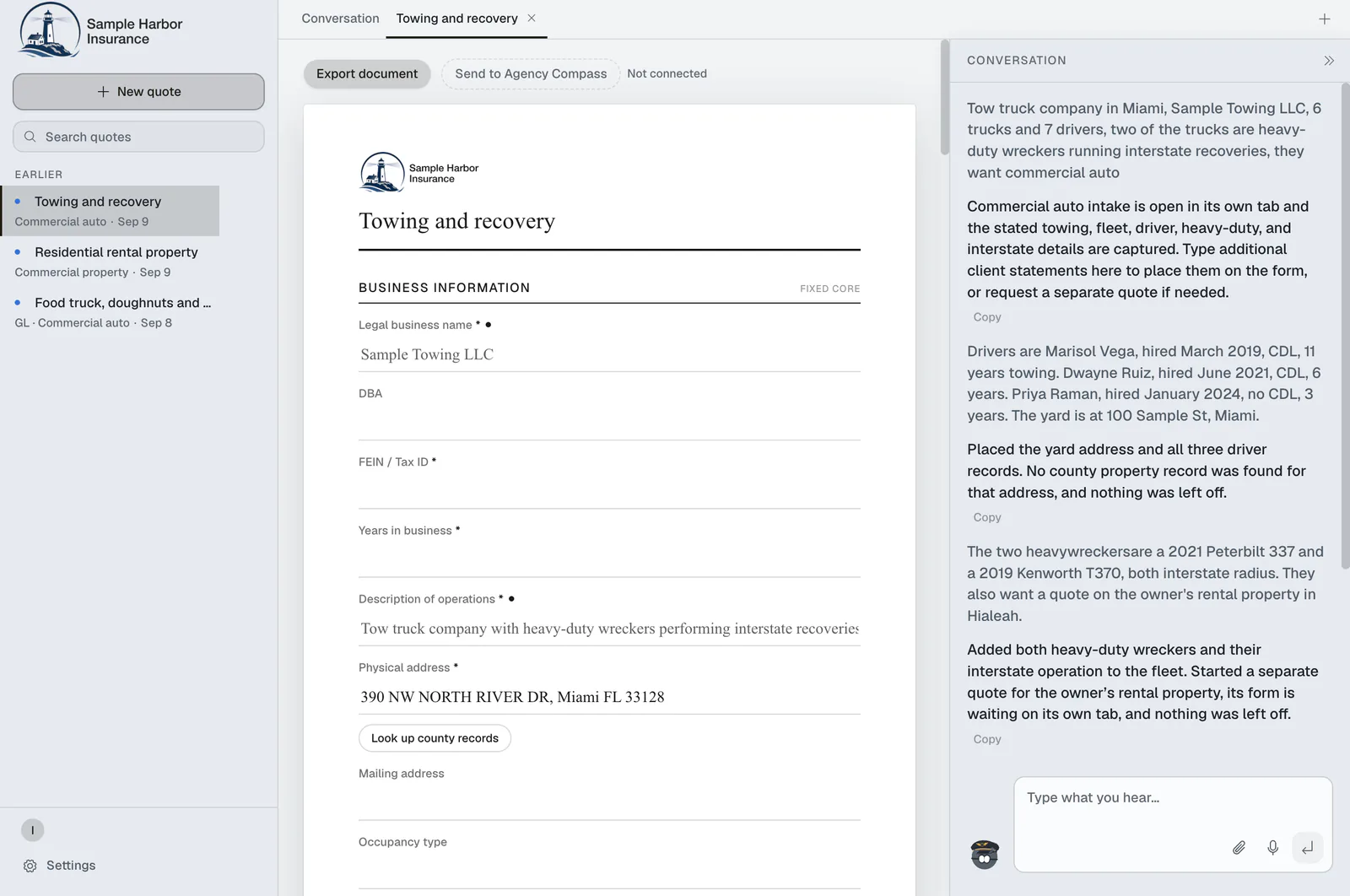
The form arrives as a tab
Your agency's fixed core first, then the sections this risk needs.
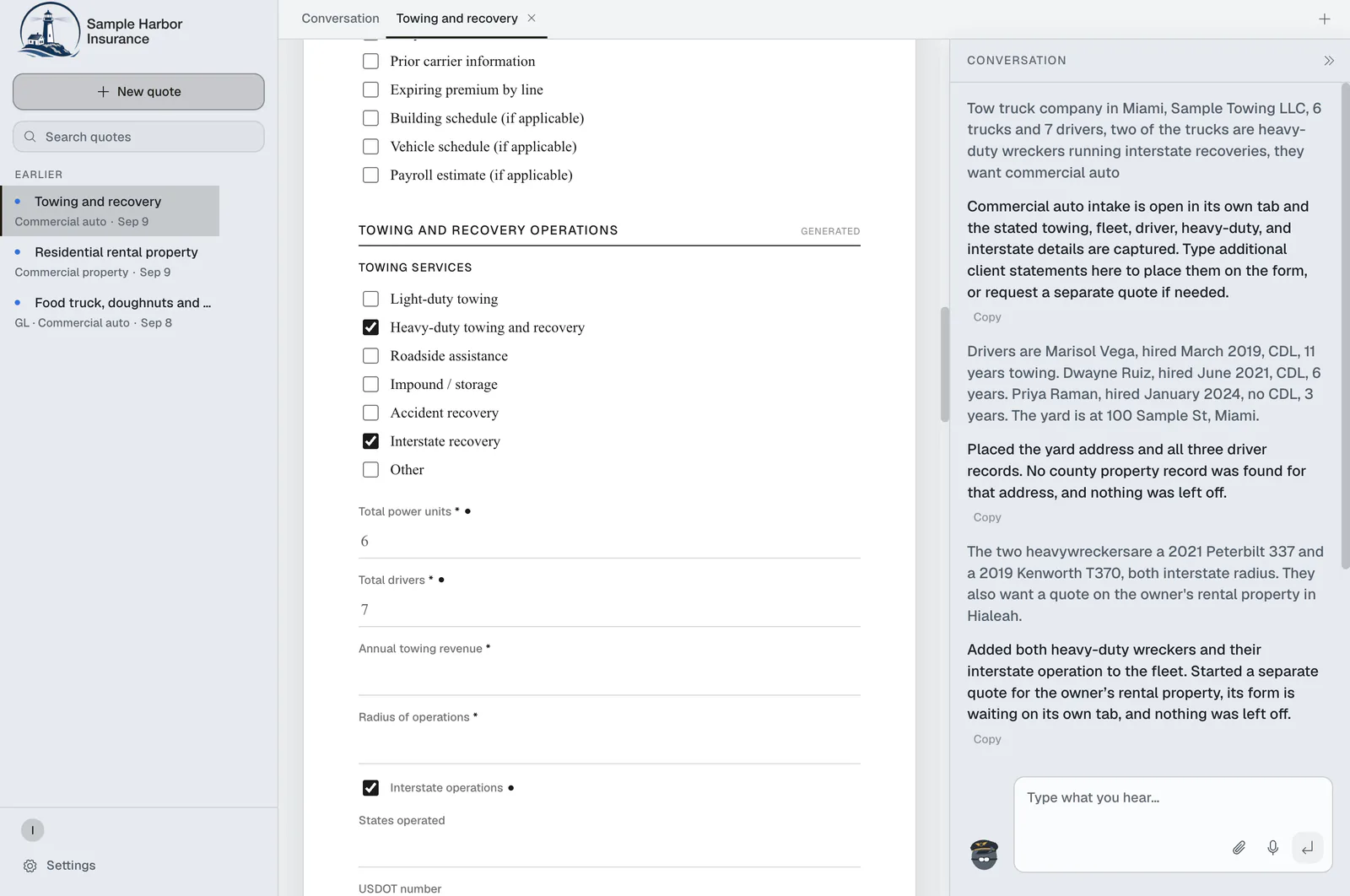
Schedules and compliance notes, on the sheet
Vehicles, drivers and payroll by class code as tables. Statute wording as the note you approved, attached where the risk needs it.
Fleet and driversGenerated
Vehicle schedule
| Unit | Year / make / model | Body type | Radius |
|---|---|---|---|
| 1 | 2021 Peterbilt 337 | Heavy wrecker | Interstate |
| 2 | 2019 Kenworth T370 | Heavy wrecker | Interstate |
| 3 | 2022 Ford F-550 | Rollback | Local |
Property at the yardGenerated
Compliance
Florida policies carry a separate hurricane deductible, commonly 2%, 5% or 10% of Coverage A, which applies per calendar year once a named storm makes landfall.
The county record, in the conversation
Type an address and the AI reads the county's record into the call: year built, square footage, owner on the roll. Nothing is filled from it.
LocationsFixed core
Built 1998 · 4,180 sq ft
Parcel 00-0000-000-0000 (sample)
Fill it while you talk
Must-asks tick off as you go. A second risk opens its own tab. The chat rides beside the form, because asking and filling happen at the same time.
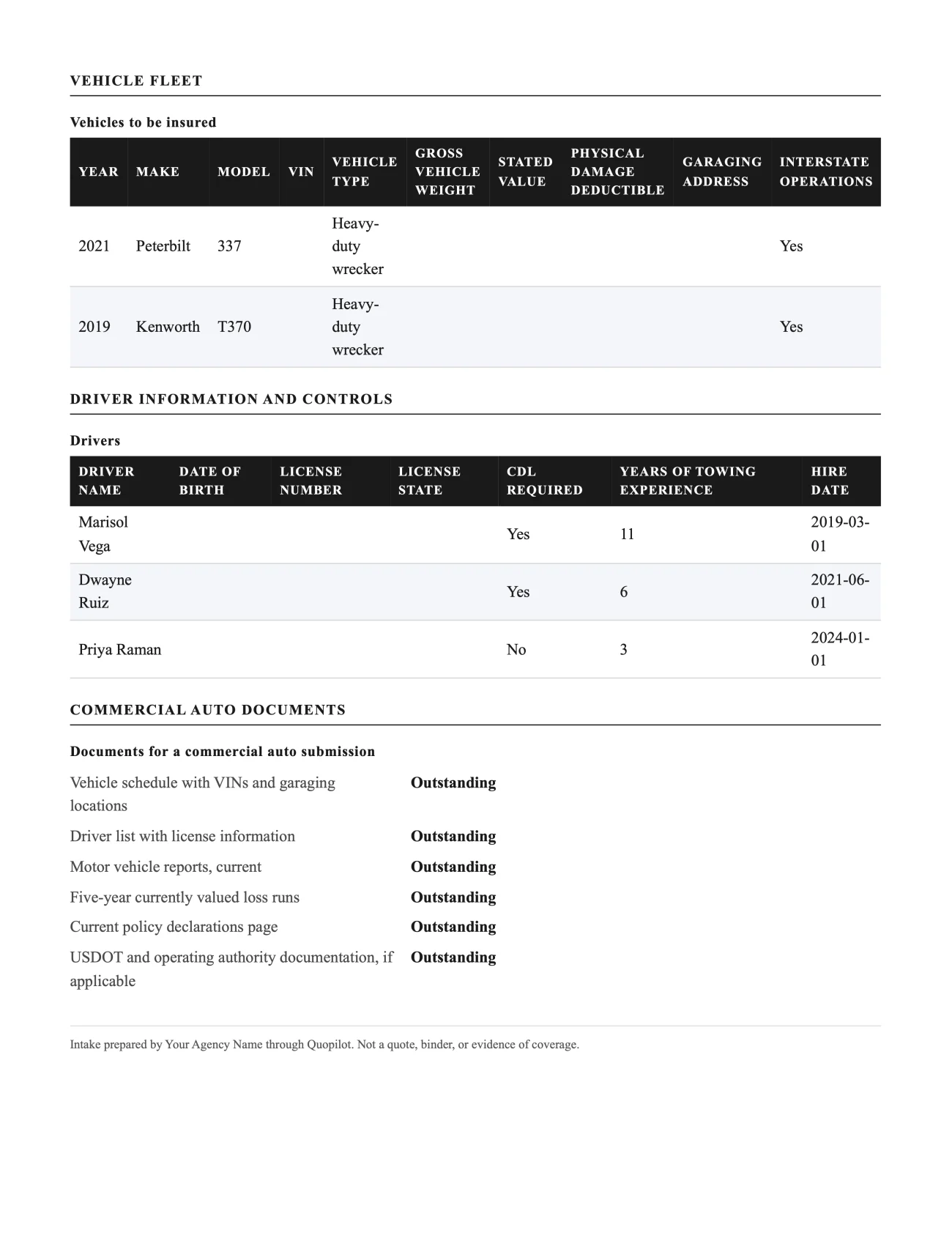
Export the PDF in your brand
One click makes the PDF the carrier gets, with your logo, your header color and your agency name on every page. Quopilot stays in the window title.
Portals and lookups, in the next tab
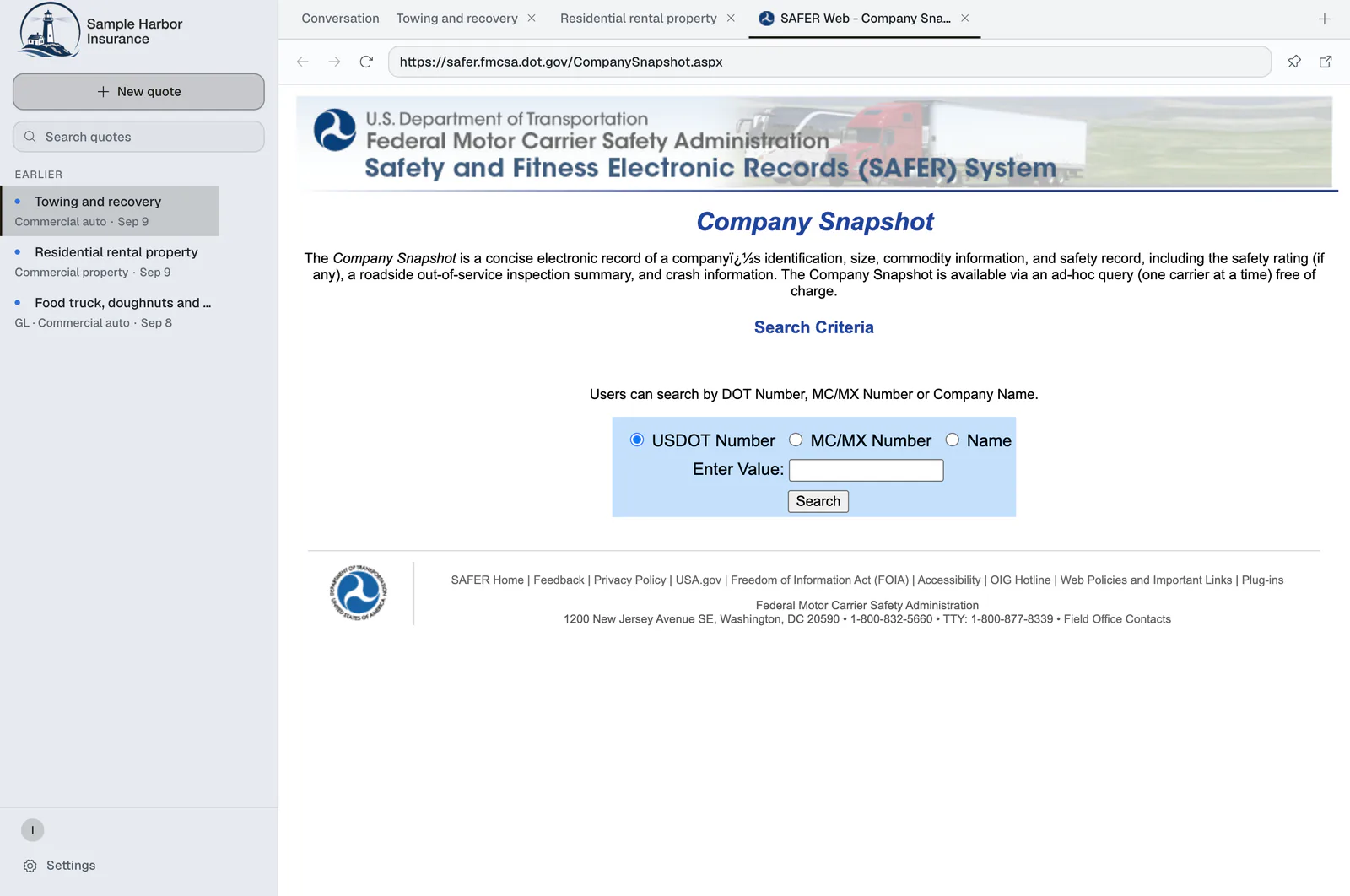
Quopilot has a browser. Your rater, a carrier portal, the FMCSA record for a trucking account: they open as tabs beside the intake, so a quote is one window instead of a circuit. The intake you just took stays one tab away while you rate.
Three steps, all on the call.
Every agency has a folder of hand-built intake sheets. The next unusual risk still gets the closest one, a CSR asking from memory, and a carrier bouncing the submission for what was missed. Quopilot builds the sheet that risk needs instead.
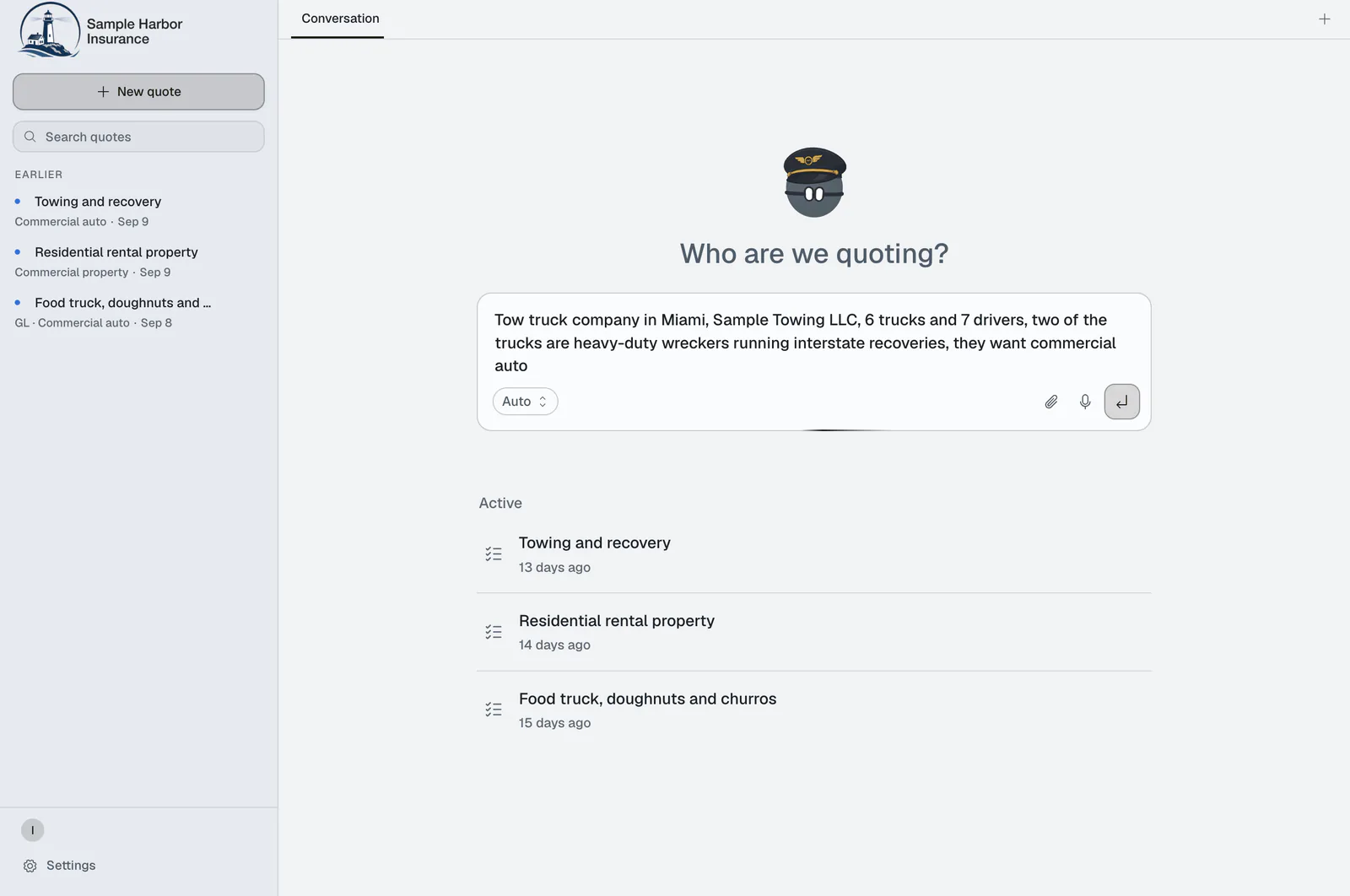
Describe the risk in one line.
"Tow truck company in Miami, six trucks and seven drivers, two of them heavy-duty wreckers running interstate recoveries, they want commercial auto."
The AI builds the form for that risk.
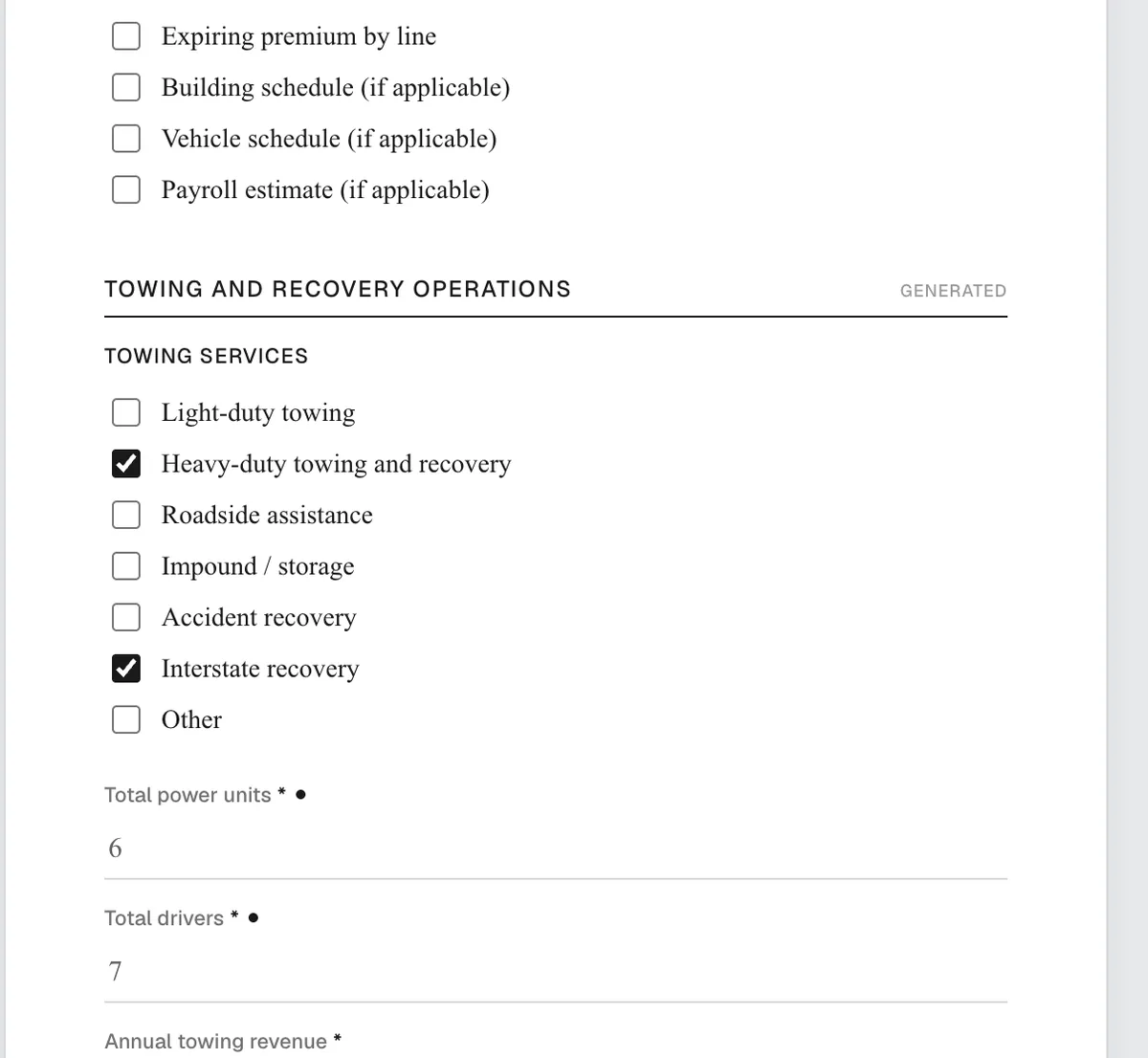
Your agency's fixed core first, then what this risk needs: a fleet schedule, a driver schedule, radius of operation, and the hurricane deductible note if the yard has a building. Type the yard's address and the county's record lands in the call.
Fill it on the call. Export the PDF.
Must-asks tick off as you go. A second risk splits into its own tab. One click makes the branded PDF the carrier gets.
Quote faster. Miss less. Retype nothing.
What changes on the desk in the first week, and what it adds up to on a busy one.
Hunt the folder for the closest sheet, then improvise the rest.
Type the risk. The AI builds the sheet it needs in about ten seconds.
Ask from memory. The carrier bounces the submission for what was missed.
The must-asks are on the form and tick off as you go. Carrier-ready in one call.
Vehicles, drivers and payroll typed into a paragraph.
Tables with rows, the way the carrier reads them.
Whoever remembers the hurricane deductible note adds it.
Your curated note is attached wherever that risk needs it. The AI cannot write one.
Leave the intake for the rater, then a carrier portal per market, then back again to find what you wrote down.
The rater and the carrier portals open as tabs beside the intake, so the risk you just took is on screen while you rate it.
Retype the notes into the AMS.
One press writes the record into your AMS, attaches the carrier-ready PDF and files the task.
Look the parcel up on the county site and retype what matters.
Type the address. The AI reads the county's record into the call and files a pasted record's facts into their fields.
A visitor who stops halfway through the quote form is gone.
The contact card comes second, so a half-finished form is still a lead you call.
Intakes a month across the desk
The AI's form-building time for all four hundred
Of them retyped into your AMS
Twenty quotes a day is a working assumption for a busy desk, not a measurement. The ten seconds is measured. Everything else on this row is arithmetic on those two.
What a generated form is made of.
Your core, not ours.
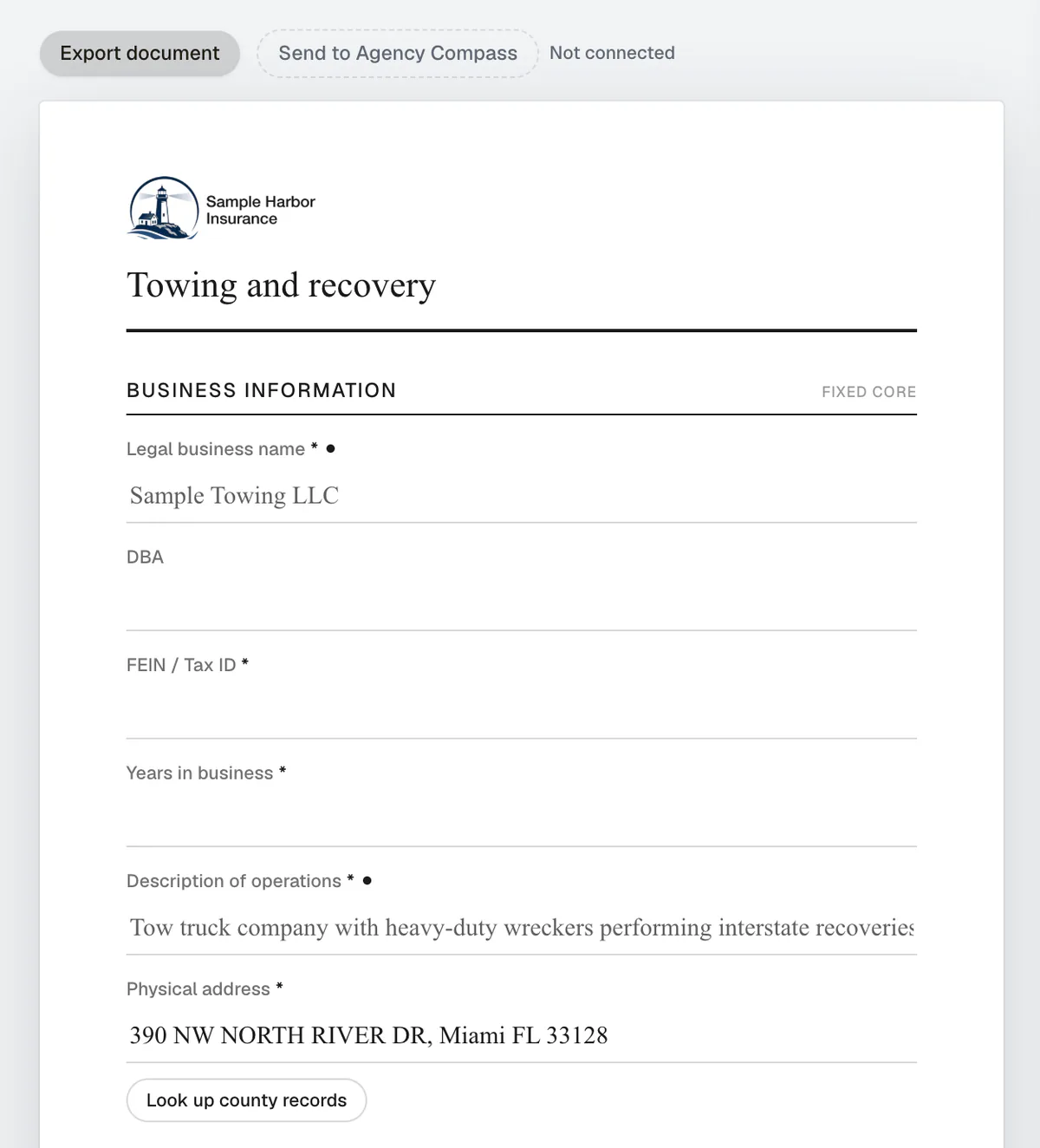
The first sections are fixed and yours: business information, contacts, owners, mailing address, effective date. The AI writes only the risk sections after them. One core for commercial risks, one for personal lines, both from your own SOP.
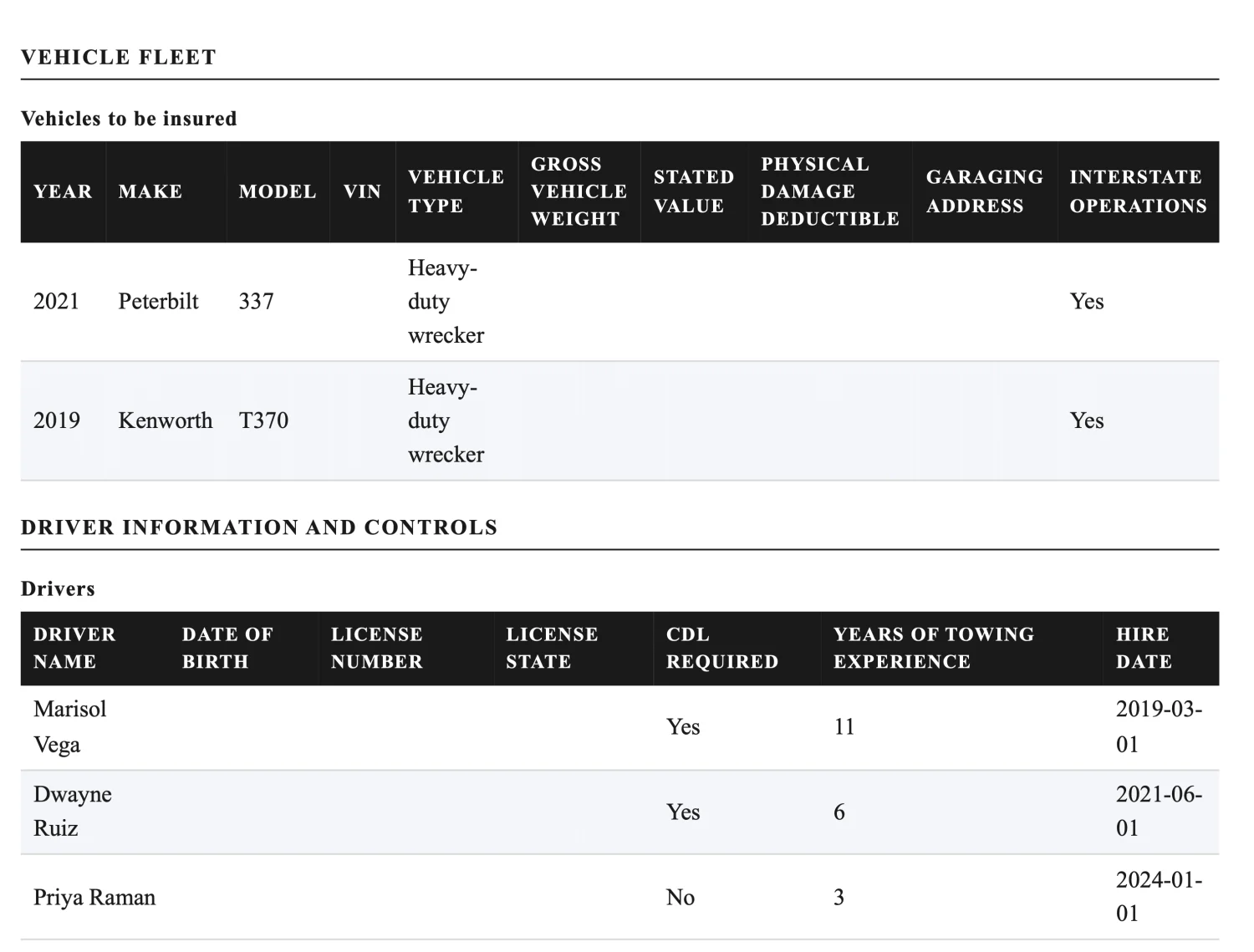
Schedules as tables.
Vehicles, drivers, locations, payroll by class code: real tables the CSR adds rows to, not a paragraph a carrier has to parse.
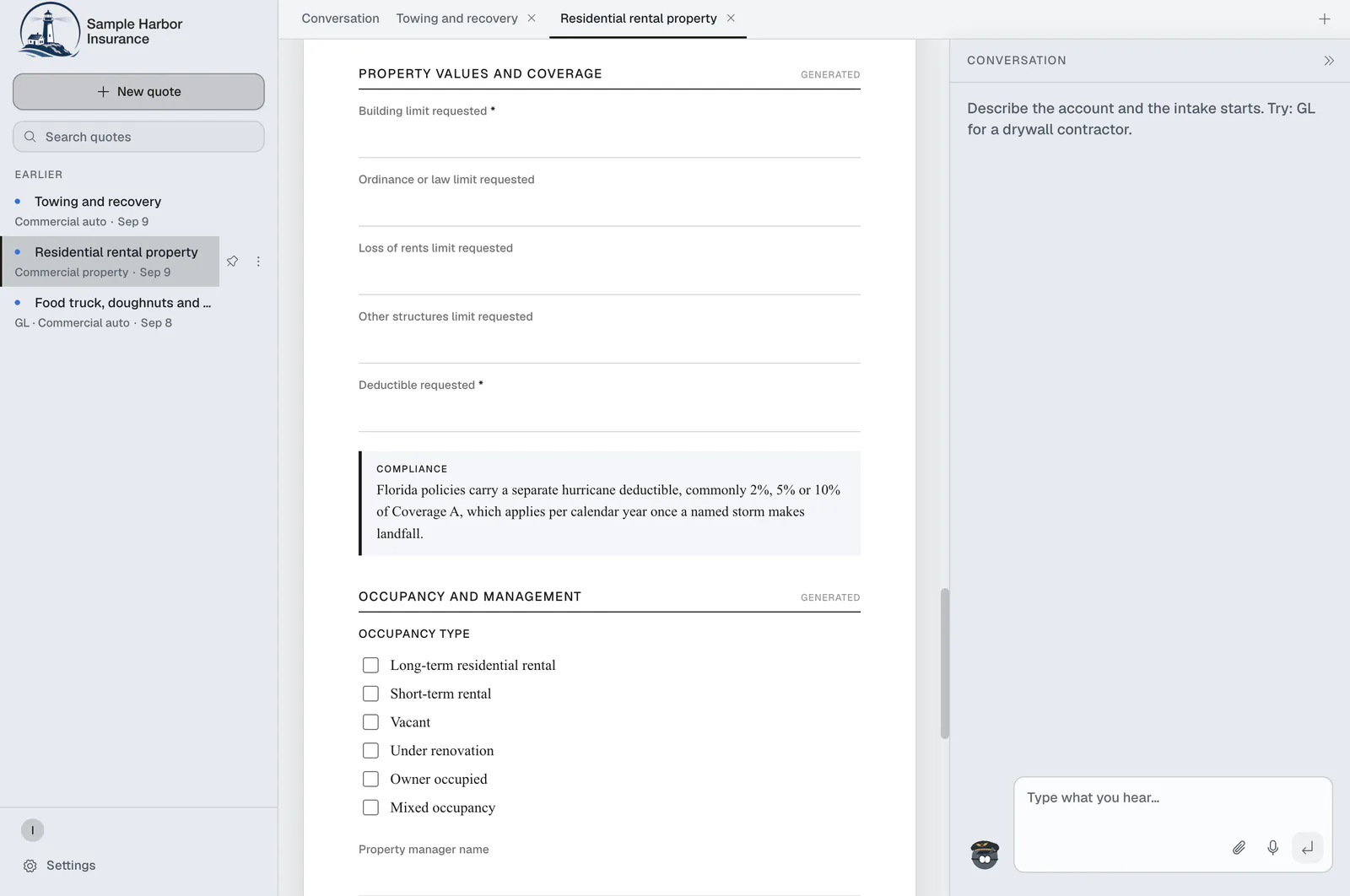
Compliance notes, curated with you.
Statute wording and the acknowledgment the client signs are curated text reviewed with an agency. The model can attach a note to a section. It can never write one.
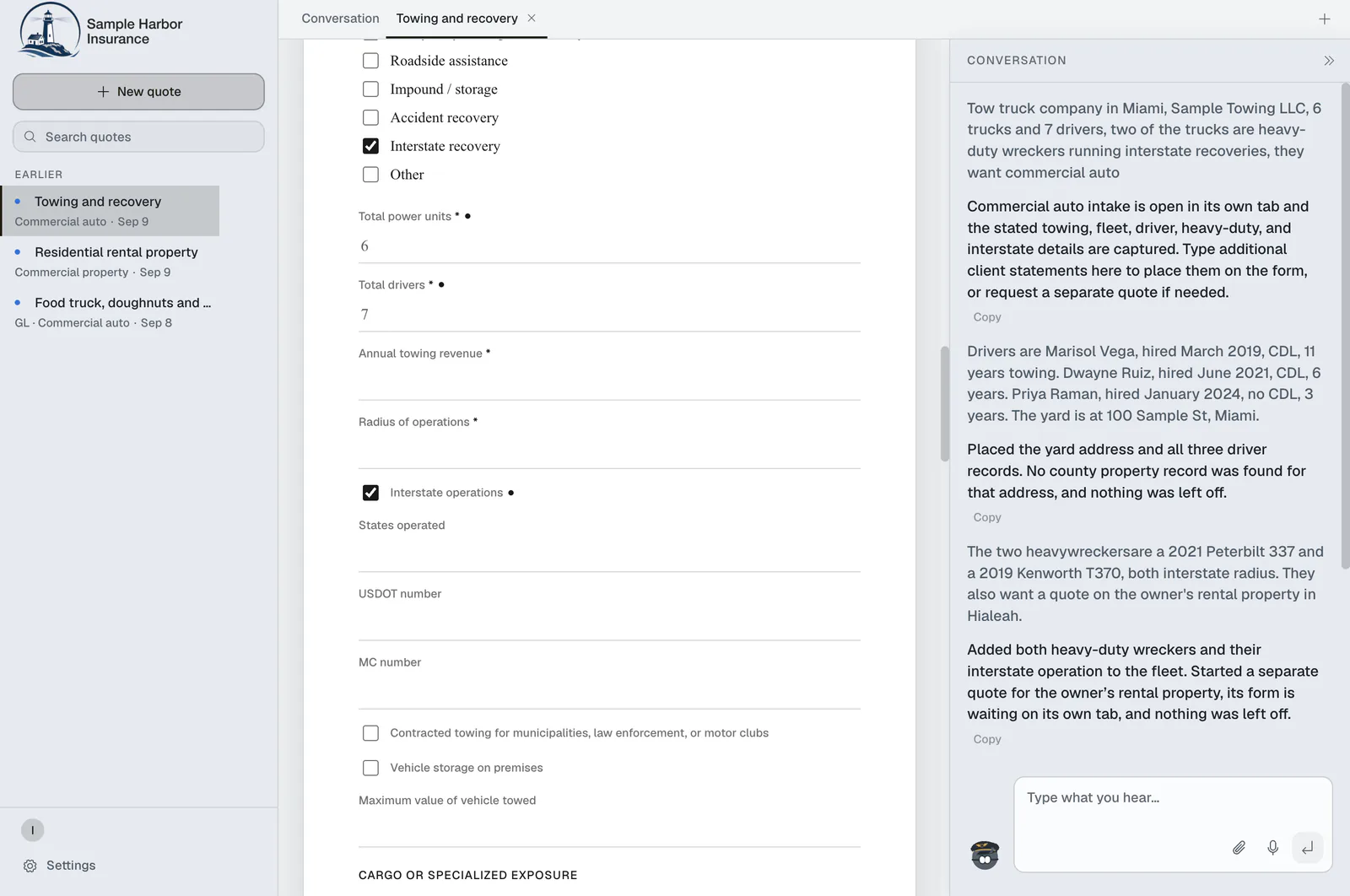
Nothing invented.
A field fills only when the CSR's own words support it, and every filled field shows where its value came from. Reading is allowed, deriving is not: payroll is never turned into revenue.
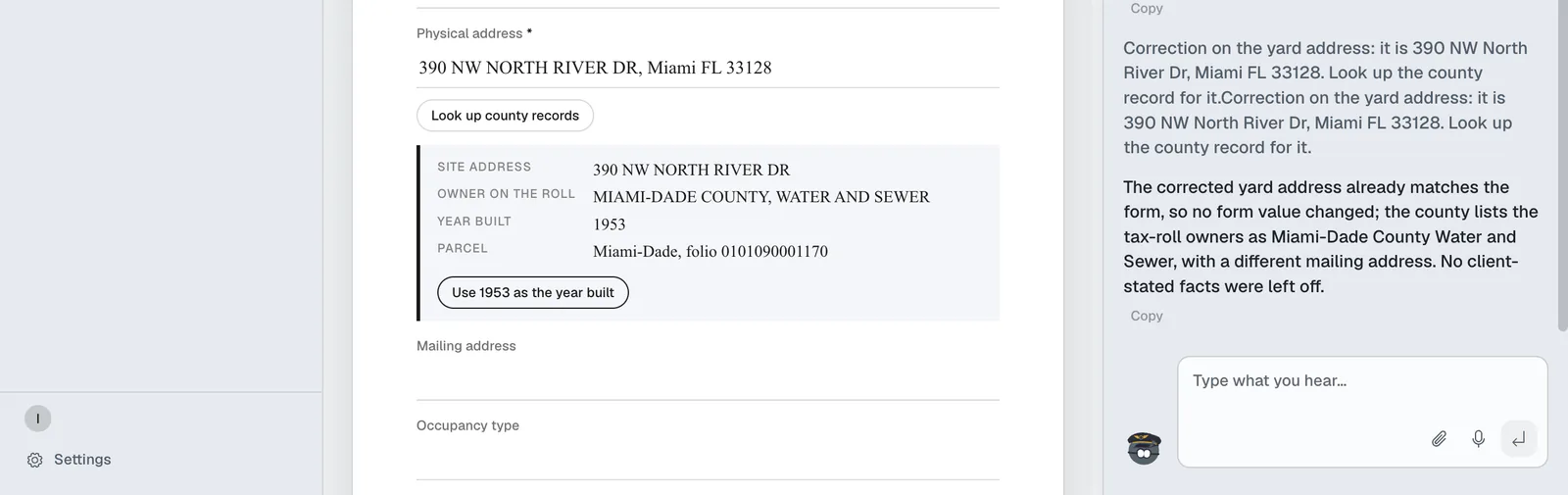
Property and owner records, matched by AI
Type an address and the AI reads the county's record into the call: the owner on the tax roll, the site address, the year built and the folio, for your CSR to confirm. It changes no field on its own. Paste an appraiser's page and it files every fact into its field and names the ones it could not place. Miami-Dade records today.
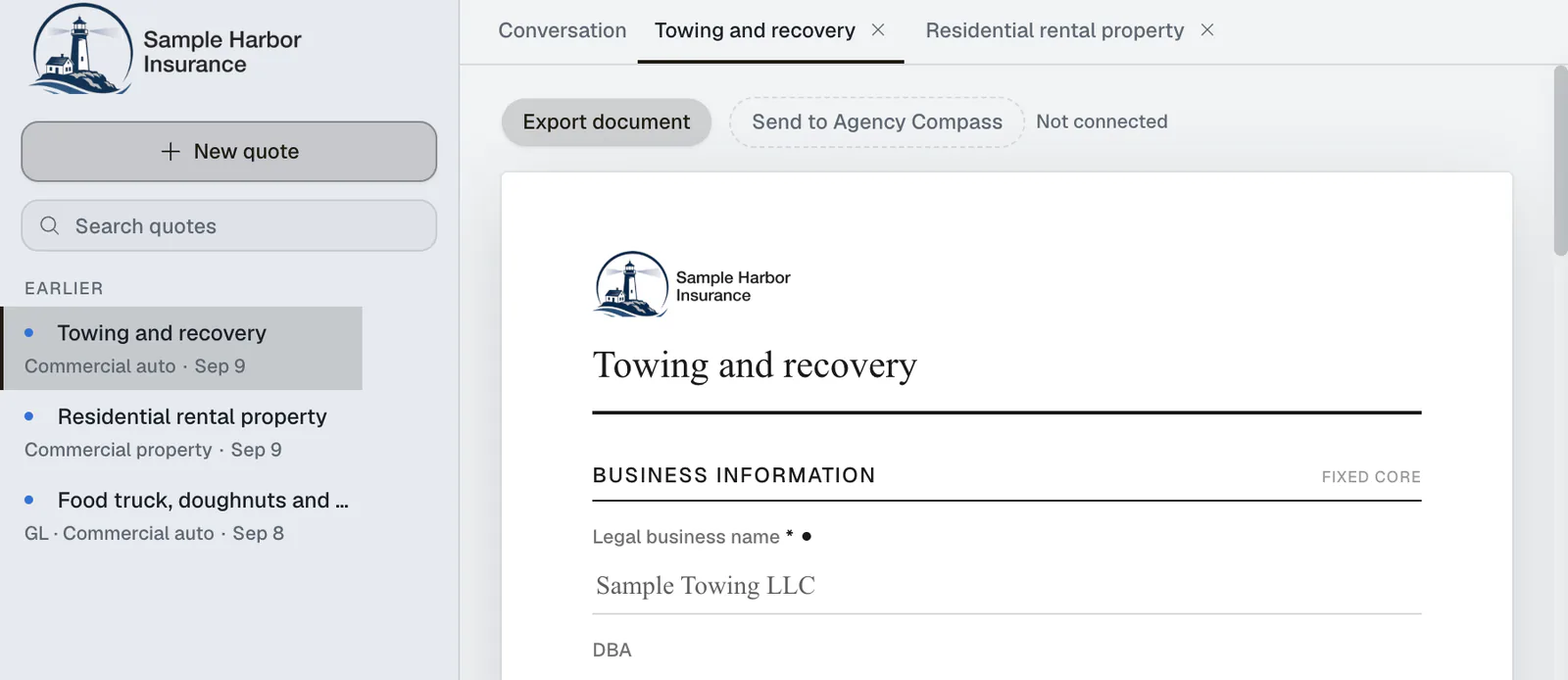
One quote per risk
"They also have a rental property" opens a second intake in its own tab, with the client's name carried over.
Your agency's name on everything the client sees.
Your name, two colours and two logos, set once in Settings. Everything your client and the carrier see after that is yours.

Tow truck company
Sample Towing LLC
Business information

Tow truck company
Sample Towing LLC
Business information
Same intake, two agencies. The colours, the mark and the name are theirs. The layout is Quopilot's.
- The app. Your accent on the active tab, the send key and the focus ring. Your mark in the sidebar and on the sheet's masthead. You upload two, one for each ground.
- The sheet and the PDF. Your logo, your header colour and your name on every page of the export the carrier opens.
- The website form. The quote form on your site takes your accent and signs off with your agency's name. Nothing on it says Quopilot.
Our name stays in two places: the window title, and the line at the foot of the PDF, "Intake prepared by your agency through Quopilot."
Your website quotes too.
The AI that builds your CSR's intake also runs the quote form on your own website. Same must-asks, with nobody on the call.
 Sample Harbor InsurancePersonal Commercial Claims Get a quote
Card 1 of 6
What do you need to insure?
Select everything that applies.
Card 2 of 6
Where should we reach you?
We'll reach out either way. Answer a few more questions next and your quote comes back faster.
The first two cards on a sample agency's quote page. The questions that follow are written for the risk the visitor typed.
One script tag
It goes on the quote page you already have. No new page, no second form to keep up to date.
Questions written per risk
Three to four cards, four to sixteen questions, built from what the visitor typed. The same must-asks your CSR works from.
Contact card second, review last
A visitor who leaves a phone number and stops halfway is still a lead you call.
English and Spanish
The AI writes the cards in whichever language the visitor uses. Your consent wording is versioned.
Every answer in your inbox
Each lead reaches you by email with every answer the visitor gave, the half-finished ones too.
Rate limits and honeypots
Per-IP and per-key limits, a spend breaker and two honeypots. A bot cannot run up your model bill.
Live on an agency's quote page today.
The lines the AI does not cross.
Write a statute.
Compliance notes and acknowledgments are curated text the server holds. The AI picks one by id and attaches it where the risk needs it. The wording is never the AI's.
Put the tax-roll owner on your form.
The owner on the county's roll is context for your CSR, never your client's name. Year built is the one value the AI takes from a record.
Say "we insure".
A wording validator holds the app to "we place, never we insure", on streamed text and on any label the AI writes. FS 626.9541 is the reason it exists.
Pretend a submission reached your AMS.
No sentence on screen says the record reached your AMS until the server confirms it. A stall is worded as a stall, and it tells your CSR to check before pressing again.
Your quotes stay scoped to your agency. The model provider keeps none of the calls. Every export ends with "Not a quote, binder, or evidence of coverage."
One product. Pick the volume.
No per-seat count, and no feature held back on the cheaper tiers. They differ by how many intakes your CSRs take at the desk, because that is the only thing that moves what it costs us to run.
Desk
$99/ month
$1,008 billed yearly
A small agency, or one producer who quotes all day.
- 150 desk intakes a month, no overage
- Unlimited website intakes
- Every CSR in the agency
- The Windows desktop app, signed, updating itself
- Your name, colours and logos on the app and the PDF
- The AMS connection, on one press
Agency
$279/ month
$2,844 billed yearly
Twenty a day across the desk, five days a week.
- 400 desk intakes a month, no overage
- Unlimited website intakes
- Every CSR in the agency
- The Windows desktop app, signed, updating itself
- Your name, colours and logos on the app and the PDF
- The AMS connection, on one press
Busy desk
$499/ month
$5,088 billed yearly
Several CSRs quoting through the whole book.
- 800 desk intakes a month, no overage
- Unlimited website intakes
- Every CSR in the agency
- The Windows desktop app, signed, updating itself
- Your name, colours and logos on the app and the PDF
- The AMS connection, on one press

Questions agencies ask.
Anything we haven't covered, ask us at contact@perspicality.com.
Which lines of business does it handle?
Commercial and personal. The AI builds the form from the description, so an unusual risk gets sections of its own instead of the closest sheet in your folder.
Does it connect to my agency management system?
If it has an API, yes. One press creates the record, attaches the carrier-ready PDF and files the task on the CSR who sent it. Nothing on screen says the data arrived until your system confirms it. Agency Compass is connected today. A system with no API still takes the same branded PDF.
What does it run on, and where does our data live?
A Windows desktop app that updates itself, signed by the company that makes it. The AI runs on our servers, and our model provider keeps none of the calls. Each CSR signs in as themselves, and every quote is scoped to your agency.
Can it listen to the call?
Not the caller. Your CSR can talk instead of type, because the microphone puts their own voice into the composer. Florida is a two-party consent state, so Quopilot never records the person on the other end.
Is it white label?
Your name, two colours and two logos, set once in Settings. They land on the app, the intake sheet, every page of the PDF and the quote form on your website. Ours stays in the window title and in one line at the foot of the PDF.
How is it priced?
One fee per agency, every CSR included, monthly or yearly. The tiers differ by how many desk intakes a month the fee covers; the website form is never counted. Past the allowance, new desk intakes wait for the next month, or you move up a tier. There is no overage charge, no trial and no refund: cancel any time and keep access to the end of the month you paid for.